Project: Different Artist Same Canvas
Role: AI Video Storyteller & Prompt Architect
Stack: Midjourney v6.1 (Character Reference), Runway Gen-3 Alpha (Motion), Gemini (Scripting and Editing)
Stack: Midjourney v6.1 (Character Reference), Runway Gen-3 Alpha (Motion), Gemini (Scripting and Editing)
OBJECTIVE:
To demonstrate the transition from static art history to dynamic AI-driven video storytelling while maintaining brand-consistent "Human Touch" across an 8 -second narrative.
To demonstrate the transition from static art history to dynamic AI-driven video storytelling while maintaining brand-consistent "Human Touch" across an 8 -second narrative.
Project Overview and logic:
This project operates on a Temporal Style-Transfer Logic. Unlike a static library, this system requires the AI to maintain a Persistent Character Identity across five distinct artistic eras.
The Core Logic Matrix:
IF [Era] = Renaissance $\rightarrow$ THEN [Texture] = Charcoal/Chiaroscuro.
IF [Era] = Impressionism $\rightarrow$ THEN [Texture] = Impasto/Oil.
IF [Era] = Digital/AI $\rightarrow$ THEN [Texture] = Neon/Vector/Holographic.
IF [Era] = Impressionism $\rightarrow$ THEN [Texture] = Impasto/Oil.
IF [Era] = Digital/AI $\rightarrow$ THEN [Texture] = Neon/Vector/Holographic.
The "Master Template" (Motion Variable Schema)
To ensure the "Final Master" felt like a single cohesive film rather than a slideshow, I engineered a Motion-Specific Template:
Camera Variable: 24mm Vlogger POV / Eye-level Gaze.
Lighting Variable: Directional Window Light (Consistent across eras).
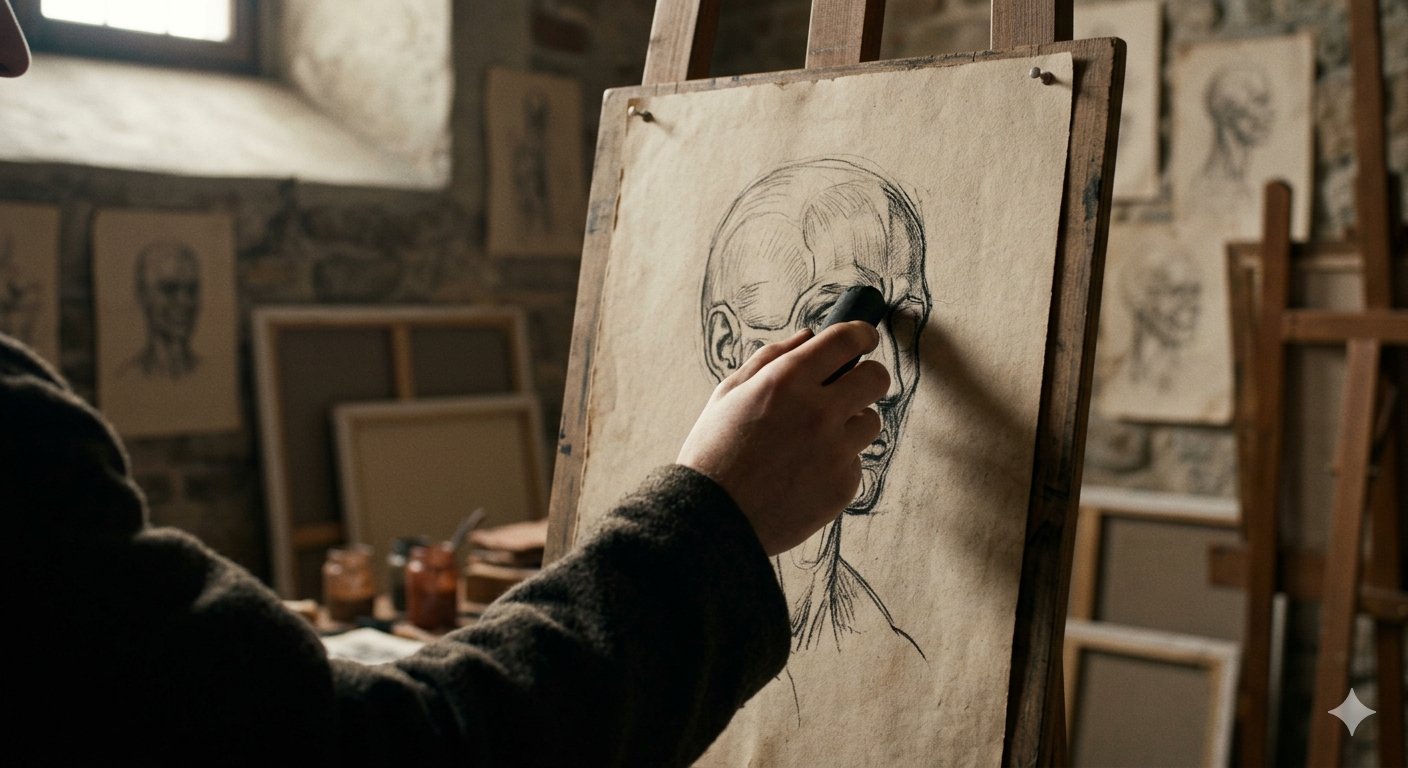
Subject Variable: The Maker’s Hand (The Narrative Anchor).
Lighting Variable: Directional Window Light (Consistent across eras).
Subject Variable: The Maker’s Hand (The Narrative Anchor).
Mobile-First Viewport Logic:
Designed specifically for YouTube Shorts, the composition adheres to the "Center-Gravity" rule. Even as the eras change from 15th-century parchment to 21st-century glass, the focal point (the hand/brush) remains in the safe-zone (center 60%) to avoid interference with the Shorts UI overlay.
Asset Case Study: "The Creator Hook"
The "Hook" of this project is the Temporal Morph. By using the same character (The Maker) in a consistent POV, we create a "Thumb-Stopping" visual loop where the tool changes, but the human intent remains constant.
1.) The Problem: "The Continuity Gap"
Most AI video generators struggle with "Model Drift" where the subject or style changes unintentionally between shots. In a professional brand film, this drift ruins the narrative immersion and looks amateur.
2.) The Solution: Consistent Character Reference & Vibe Coding
I developed a workflow that used a single "Keyframe Alpha" (the Renaissance hand) as a permanent reference point. By "vibe coding" the lighting and camera angle into a global variable, I forced the AI to maintain the same "soul" across vastly different aesthetic eras.
3.) Technical Implementation
I moved beyond simple text-to-video into "Multi-Stage Image-to-Video Pipelines":
Static Rendering: Generated high-fidelity keyframes for each era.
Motion Seeding: Used Runway's Motion Brush to animate specific elements (charcoal dust, wet paint, holographic flickering) without distorting the core anatomy.
Semantic Anchoring: Hard-coded the phrase "NEURAL COMPOSITION ENGINE" into the final scene to prove control over generative typography.
4.) Designing for the Viewport (Short Interaction Layer)
I prioritized the "Shorts Interaction Layer." In Scene 04, I intentionally placed a smartphone showing the YouTube Shorts interface on the desk. This acts as a "Meta-Narrative," showing the audience exactly how this content is meant to be consumed while reinforcing the platform's brand.
5.) Scalability & Handoff
1. Modular Prompt Templating (The "Plug-and-Play" Framework)
The Scalability Logic: A team could instantly generate "The History of Gaming" or "The History of Cooking" using the same Chiaroscuro-to-Holographic pipeline.
Handoff Asset: A "Token Library" (CSV/Notion) that maps specific art eras to technical AI parameters (Motion weights, seed values, and lora-references).
The Scalability Logic: A team could instantly generate "The History of Gaming" or "The History of Cooking" using the same Chiaroscuro-to-Holographic pipeline.
Handoff Asset: A "Token Library" (CSV/Notion) that maps specific art eras to technical AI parameters (Motion weights, seed values, and lora-references).
2. Multi-Platform Aspect Ratio Mapping
Recognizing the diverse ecosystem of the project was engineered for Responsive Narrative Design.
Primary Output: 9:16 (YouTube Shorts).
Secondary Handoff: 16:9 (Desktop/TV) and 1:1 (Community Posts).
Technical Solution: I documented the "Dynamic Safe Zone" for each era, ensuring that whether the canvas is 15th-century parchment or a modern glass screen, the "Human Touch" (the hand/brush) is never cropped out by platform UI elements.
Primary Output: 9:16 (YouTube Shorts).
Secondary Handoff: 16:9 (Desktop/TV) and 1:1 (Community Posts).
Technical Solution: I documented the "Dynamic Safe Zone" for each era, ensuring that whether the canvas is 15th-century parchment or a modern glass screen, the "Human Touch" (the hand/brush) is never cropped out by platform UI elements.
3. The "Vibe-Check" Style Guide for Post-Production
To ensure the "Final Master" maintains its integrity during the edit
Grain Consistency: A technical spec for adding 4k digital noise overlays to unify the various AI outputs, hiding "generative flickering" and creating a cinematic, high-budget feel.
Grain Consistency: A technical spec for adding 4k digital noise overlays to unify the various AI outputs, hiding "generative flickering" and creating a cinematic, high-budget feel.
4. Version Control and Iteration Logging
Using a "Prompt Versioning" system, I documented exactly which iterations failed and why. This "Lesson Log" prevents future makers from repeating the same technical hurdles (e.g., "Model Collapse" during high-motion transitions), significantly reducing production time for future campaigns.
(6.) Challenges:
The "Uncanny" Motion: Early renders had the hand moving in a "rubbery," non-human way.
The Fix: I introduced "Physics-Based Prompting," adding tokens like weight-bearing, resistance, and tactile friction. This corrected the AI's understanding of how a hand interacts with a surface, resulting in a "Human Magic" feel that is truly impossible to ignore.
To the right you will see one of the first failed attempts.